Connemara Facts: Marconi, the Twelve Bens and a Park That Was a School Farm
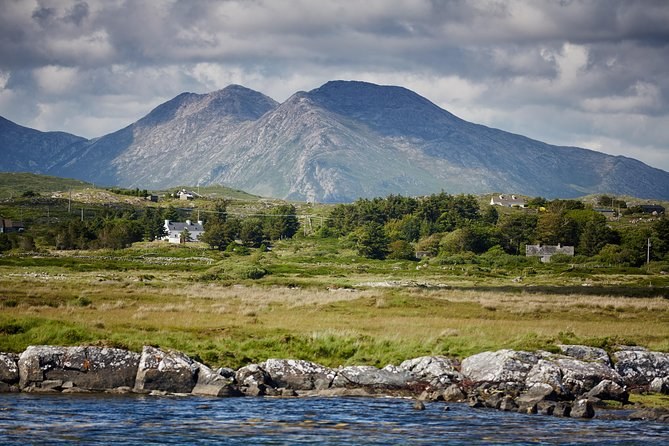
The short answer. Connemara holds the highest peak in County Galway, one of Ireland's three glacial fjords, and a national park built partly on the farm of a former industrial school. Marconi worked on two-way radio in a room there in 1911. The first non-stop flight across the Atlantic ended in a bog near Clifden. Here are the facts, and where you can stand to see each one.
Most of what makes Connemara surprising is not on a sign. The park office was once a school infirmary. The castle by Lough Corrib held out against Cromwell. You can see where each story happened on a day out of Galway, as long as you know where to look.
Benbaun is the highest peak in County Galway
At 725 m, Benbaun is the top of the Twelve Bens and of the county. It is one of four peaks inside Connemara National Park, with Bencullagh, Benbrack and Muckanaght. You will not climb it on a tour. You can see it, though: the summit of Diamond Hill, on the park's red trail, looks straight across at the range.
Marconi worked in the school infirmary
In April 1911, Guglielmo Marconi rented a room in the Letterfrack infirmary. The building is now the park office. There he began work on the world's first full duplex two-way radio, with aerials strung between Diamond Hill and Mweelin. The patent followed in 1912. His station at Derrygimlagh, near Clifden, had already sent the first commercial transatlantic wireless messages, to Glace Bay in Canada, in 1907.
The first non-stop transatlantic flight ended in a bog
Alcock and Brown's aircraft crash-landed in the bog at Derrygimla, just south of Clifden, at the end of the first non-stop flight across the Atlantic. A bronze statue of the two men has stood on Market Square in Clifden since 2020. A tail-fin monument from 1959 stands on Ballinaboy Hill. If your day stops in Clifden, you can find the statue in a few minutes.
The national park was once three estates
Connemara National Park opened to the public in 1980. Its 2,000 or so hectares include land that was once part of the Kylemore Abbey estate, land that belonged to Letterfrack Industrial School, and land owned by Richard "Humanity Dick" Martin. Martin helped found the Society for the Prevention of Cruelty to Animals. Today the State owns all of it.
The visitor centre was the school farm
The park's visitor centre stands in the farm buildings of Letterfrack Industrial School. The school's graveyard lies inside the park. The park keeps it as a place of remembrance for the boys who suffered abuse there. If you visit, treat it as that.
Quaker families gave work in the famine years
Mary and James Ellis and Sophia Sturge were Quakers who came to Letterfrack and gave people work during the famine years. Part of the Ellis property, and Sturge's basket factory, now lie inside the park. The park's free exhibition covers how the land was used, from the last ice age on.
Killary is one of three fjords, not the only one
You may hear Killary called Ireland's only fjord. Discover Ireland counts three: Killary Harbour, Lough Swilly and Carlingford Lough. Killary runs 16 km and forms the border between Galway and Mayo, with Mweelrea, the highest mountain in Connacht at 814 m, above it. Lally Tours' days give you fifteen minutes on its shore.
Aughnanure Castle held out against Cromwell
Aughnanure Castle is a tower house from the late 15th century, on a rock over the Drimneen River near Oughterard. The O'Flaherty lords of Iarchonnacht held it for more than two centuries, and it resisted the Cromwellian blockade of Galway. After the 1641 rebellion the lands were taken. Peadar O'Flaherty gave the castle to the State in 1952, and it opened to visitors in 1974. Entry is EUR 5 for an adult.
Kylemore was a family home, then an abbey
Mitchell and Margaret Henry began building Kylemore in 1867, on an estate that now covers 1,000 acres. Benedictine nuns have lived there since December 1920, which is why the upper floors are closed to visitors. The abbey sits across the lough from the national park. It is not inside Connemara National Park, though the two share a border.
A railway line is becoming a greenway
A railway once ran from Galway to Clifden. Its line is now the route of the Connemara Greenway, which will give about 76 km of traffic-free trail once it is complete. It is only partly built. About 6 km is open at Ballynahinch and 3.5 km in Clifden, plus 4 km in Galway city. If you cycle, those are the sections to ride; the rest of the route is still road.
The park may soon have its own law
Ireland's national parks run without a law of their own. On 24 July 2026 the Minister of State announced plans for a National Parks Bill to put them on a statutory footing, Connemara among them. It is a plan, not yet a law, but it may change how the park is run in the years ahead.
Irish is the everyday language on much of the coast
Connemara is one of Ireland's largest Gaeltacht regions. On the coast road through An Spidéal, the signs, the shops and the talk are in Irish. The Irish name for the Twelve Bens is Na Beanna Beola.
Where to see each fact on a day out
| Fact | Where you see it | Which day gets you there |
|---|---|---|
| Benbaun and the Twelve Bens | From the summit of Diamond Hill | A park day with 3 hours |
| Marconi's room | The park office, Letterfrack | Any park day |
| Alcock and Brown | The statue on Market Square, Clifden | A day with a Clifden stop |
| Killary, the fjord | The shore at Leenane | Lally Tours' days |
| Aughnanure Castle | Near Oughterard, off the N59 | A private day that stops there |
| Kylemore Abbey | The estate, 5 km from Letterfrack | Any Kylemore day |
More on each place is in things to do in Connemara and the national park guide. For the road between them, see Connemara stops, one by one, and for opening days, plan your trip.
Two ways to stand where the stories happened
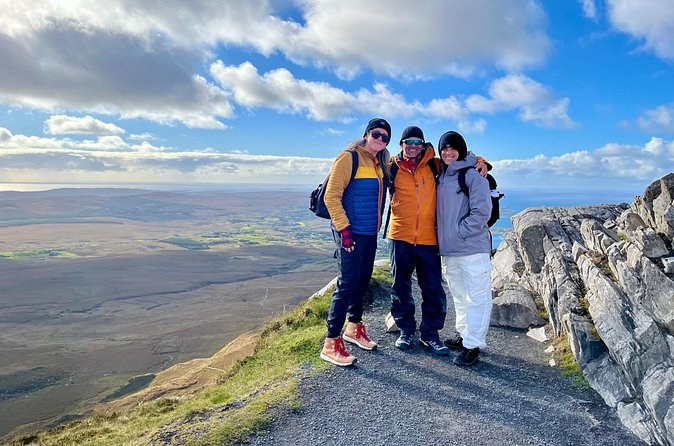
Hike Connemara National Park Full Day Tour
A guided hike for your group alone: three hours on the national park trails, plus a sheepdog demonstration and an hour in Leenane, with pickup in Galway city.
From $228 per person
Check Availability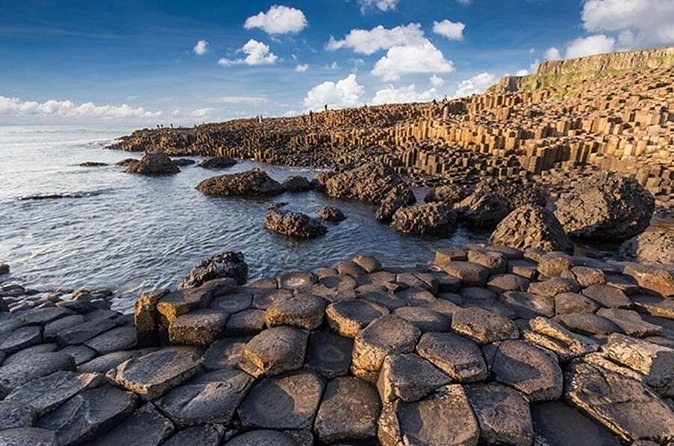
5-Day Northern Ireland and Atlantic Coast Small-Group Tour from Dublin
Five days from Dublin by Belfast, the Causeway coast, Derry and Donegal, with a Connemara day and an hour at the national park visitor centre.
From $1,528 per person
Check AvailabilityNext: pick the story you most want to see, then the day that stops there. Every fare sits side by side on Connemara Tours.